War Horse meets Matthew Bourne meets DV8. A fascinating mix of puppetry, physical theatre, and music.
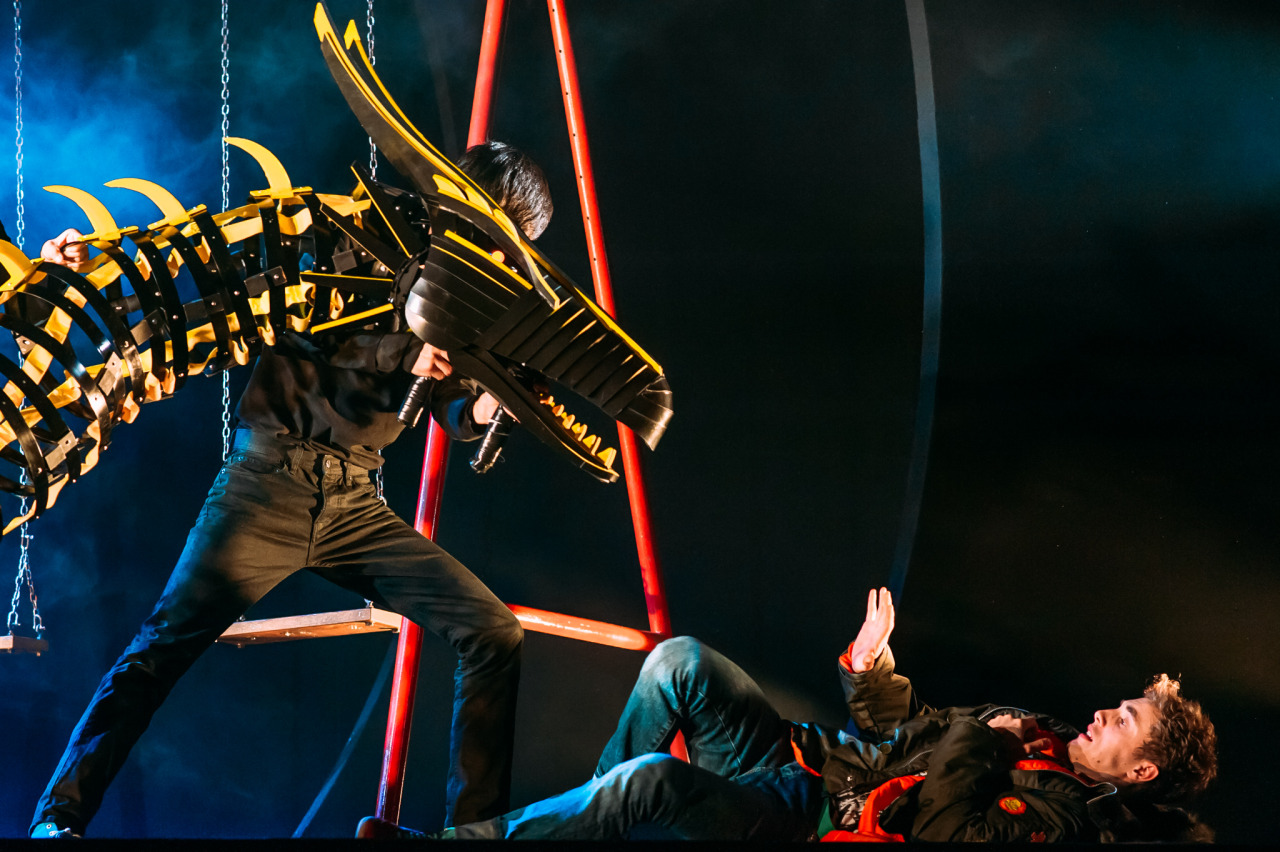
Last night, I saw Dragon at The Citizens Theatre in Glasgow; a co-production between the National Theatre of Scotland, Vox Motus, and Tianjin Children's Art Theatre. Like DV8 and New Adventures, this story was told almost entirely without words. The Narrative begins when the main character - Tommy - loses his mother. he soon begins to see a Chinese dragon in a number of forms, the first of which being an apparition in a street lamp, a la Marley's ghost in the door knocker in A Christmas Carol.
There are many ways in which to interpret the various manifestations of this dragon, one of which being that they represent the contrasting stages of grief. The fact that - to my recollection - there were seven distinct dragons certainly feeds into this idea. The second vision of Tommy's, supposedly formed from a chair in his bedroom, hits him on the head with a book, which Tommy had just thrown in fear. This could be an indirect act of self punishment, representing his regret and self hate surrounding his mother's death. This is followed by a red, fierce dragon; a house-sized, winged dragon that Tommy rides over the rooftops, and a big, white, protecting, Never-ending Story dragon towards the end of the play. These could denote anger, denial/escapism, and acceptance respectively. The idea that the 'denial' dragon forms from the roof on Tommy's house when he climbs up there to escape home life reinforces the concept of fantasy and avoidance with regard to his feelings of loss.
Stylistically, the puppetry used in Dragon is very much like that of war Horse, especially in how the performers become part of the puppets. In War Horse, the people controlling Joey's head, legs, and back end are all clearly visible, which somehow adds to the charm and realism of the production. It's the same deal with the various dragons in Dragon, especially the roof-denial incarnation where the head, tail, and each wing are all supported by a performer; there was definitely an air of Handspring Puppet Company about the whole aesthetic.
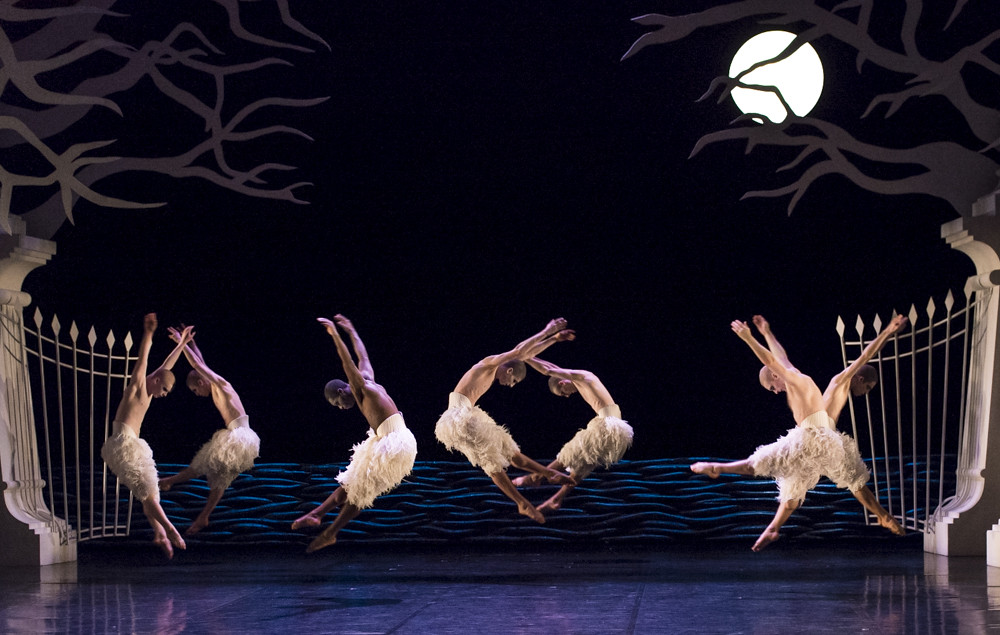
Another company that Dragon reminded me of was New Adventures. The initial vulnerability and loneliness of Tommy's character rang true of figures such as The Prince in Swan lake, Angelo in The Car Man, and Edward in Edward Scissorhands. This mixed with the strong, tireless physical theatre of Scott Miller's performance almost made for a classic Matthew Bourne outsider.
An asset worth mentioning from this production is the minimal use of scenery; this is where similarities to companies such as DV8 come in. For instance, the fridge in Tommy's kitchen is nothing more than a performer holding a door, with the lighting timed accordingly. I also loved how the use of performers was embraced, rather than covered up, and the scenery humanised. At one point, a whole swimming pool is created out of people in blue body suits, which has to be one of the most impressive things I've ever seen on stage.
Dragon has finished its run at The Citizens Theatre, but it's off to Dundee next, and I believe it'll be touring more widely after that. It's the perfect introduction to theatre for more mature children, but perhaps a little heavy for the little ones. It is marketed as a children's production, but me and my adult friends all enjoyed and related to it, and I'd encourage anyone to see it if you get the chance.
If you enjoyed Shrek: The Musical, How to Train your Dragon, or any episode of Game of Thrones, I fail to see how you won't get your claws into this magical tail...dragon puns aren't easy, OK?
A blog dedicated to artistic discoveries, theatre and film reviews, and cultural Opinion pieces.
Sunday, 11 October 2015
Sunday, 14 June 2015
Let's Get Physical: Frantic Assembly, Matthew Bourne, and why we do it.
After a successful, career-affirming weekend, I feel compelled to share some of my personal and professional highlights from the past six years.
Recent experience has got me thinking about how and why I ended up where I did, and today I'd like to take you through some of my most vivid and prominent memories - moments which led me in the same direction and reminded me why I chose that path in the first place. I can recall four occasions in particular - two very recent - when I realised (or remembered) why I decided to study, live, and breathe theatre and performance for the rest of my life.
The first occurred six years ago, when I was a wee 17-year-old. I went on a trip with my AS Level Drama class to The Lowry in Salford; an evening I'll never forget. The performance was Othello by Frantic Assembly; a well-known physical theatre company who often re-invent classic stories for the modern stage. In this instance, Othello was a bouncer at a club (presumably somewhere in Manchester, given the accents), and the action took place either in the bar area, the ladies' toilets, or the seedy alley outside. I think it was the moment - spoiler alert! - just before Desdemona dies (having been strangled atop a pool table) when I decided that this was what I wanted to do. Not necessarily physical theatre, or Shakespeare, but just something that made me feel this way again. To be able to create, or be part of, something that would give me the same pride as those performers - from that day on - became my ambition. This gives me an excuse to dig out an essay I wrote three years later, in my second year of uni, about this very performance:
Pieces such as Othello show just how creative FA can be with original, or found, text; their adaptation of scripts shows their ability to take ownership of words. Even in the early stages of rehearsal, the company focus on the type of world they aim to transmit throughout a particular piece. They believe that this is a delicate process, easily disturbed. Later on in the course, these ideas will transfer onto the scenographic choices of the piece; Othello's gritty, contemporary reality is a prime example.
This leads me nicely to the next experience I'd like to share. Fast forward five years; I graduated, travelled, auditioned, free-lanced, temped, and eventually found myself in Glasgow in my current role. I hadn't lived in the city a week - it was my fourth day at work and I was acting as a 'secret shopper' among my own staff. The show this time was Matthew Bourne's Swan Lake. The run had gotten off to a great start, when, during the dress rehearsal, the fire alarm sounded and we had a sudden swan evacuation. This must have been a hell of a sight for unknowing passers-by. It was now Thursday night, so three days into the run. I'd heard great things about Matthew Bourne, and Facebook told me that an old school friend of mine was now a dancer in his company. My knowledge of his work, however, amounted to the fact that it was this very production of Swan Lake that features at the end of Billy Elliot. My ignorance ended that night. For the first time in my life, my stomach was in knots with excitement and emotion throughout the performance. It was the first of many times that I would sit in "my" theatre, and I choked back tears at the end of the show, primarily because this stunning male swan (Jonathan Ollivier) and his fellow cast had made me realise what an exciting chapter I had entered into, and that, in my own, small way, I'd 'made it'.
My third, and penultimate, reminder of why it was all worth it came over a year later. A serious injury had put a sudden stop to any dancing, sport, or physical theatre I might have pursued. And am-dram just wouldn't have worked with my hours. Having worked in management - albeit theatre management - for most of my career, the creative, performing part of my brain was beginning to get restless. Something was amiss and I didn't know what it was. One Sunday, after months of casual email to-and-fro-ing and the occasional meeting, I found myself at another local theatre, this time on a voluntary basis. I'd decided to try my hand at teaching (something I hadn't done since my second year of uni) and ended up very much involved with various acting workshops. I'd forgotten how incomparable it is to work with young performers; the ideas and engagement that came out of those sessions is something you just don't get with adults. I knew that afternoon that this was what had been missing, and that this would help me to be me again. It transformed that gloomy non-day that is Sunday into something to look forward to; wondering what those minds would surprise us with week after week.
So, that brings us to the most recent example of that epiphany-like sensation. This happened just two days ago, when, once again, the physical theatre/contemporary dance bug struck. I'd booked tickets to see Matthew Bourne's The Car Man at Edinburgh Festival Theatre (can you see a theme emerging?). For those who don't know, this -like all Matthew Bourne work - is a modern re-telling of Bizet's Carmen (the opera). I know nothing of the original story, but - as ever, this really didn't matter. I was glad to have taken my seat early; the stage came to life about fifteen minutes before curtain up, as the performers began to move around and interact in character. My eye was drawn to the vulnerable, withdrawn Angelo at the edge of the stage, played by Dominic North whom I'd seen as Edward Scissorhands in November. Just seeing him and remembering his last performance was enough to know that this wouldn't be a disappointment. As soon as the house lights went down and the score began, that feeling returned - let's call it The Swan Lake Effect - the knots, the butterflies...and it was as if I was being welcomed home, having been away for far too long. I should emphasises that I've worked and performed in theatres for a long time - this production instantly earned its spot in my 'top three' performances ever. It's a brutal selection process, believe me.
Why am I telling you all this? Well, whether you're a performer, writer, director, techie, critic, or even a manager - it's important to know why we do what we do. Especially if we reach a rut for whatever reason. As Christopher Isherwood once wrote, "A few times in my life I've had moments of absolute clarity. When for a few brief seconds the silence drowns out the noise and I can feel rather than think, and things seem so sharp and the world seems to fresh. It's as though it had all just come into existence [...] I have lived my life on these moments. They pull me back to the present and I realise that everything is exactly the way it was meant to be".
So, if - like me - you ever feel as if you've lost your way in this world of competition, ambition, disappointment, and change; try to remember that first time, and the good times. Trust me - you'll find your way home.
Recent experience has got me thinking about how and why I ended up where I did, and today I'd like to take you through some of my most vivid and prominent memories - moments which led me in the same direction and reminded me why I chose that path in the first place. I can recall four occasions in particular - two very recent - when I realised (or remembered) why I decided to study, live, and breathe theatre and performance for the rest of my life.
The first occurred six years ago, when I was a wee 17-year-old. I went on a trip with my AS Level Drama class to The Lowry in Salford; an evening I'll never forget. The performance was Othello by Frantic Assembly; a well-known physical theatre company who often re-invent classic stories for the modern stage. In this instance, Othello was a bouncer at a club (presumably somewhere in Manchester, given the accents), and the action took place either in the bar area, the ladies' toilets, or the seedy alley outside. I think it was the moment - spoiler alert! - just before Desdemona dies (having been strangled atop a pool table) when I decided that this was what I wanted to do. Not necessarily physical theatre, or Shakespeare, but just something that made me feel this way again. To be able to create, or be part of, something that would give me the same pride as those performers - from that day on - became my ambition. This gives me an excuse to dig out an essay I wrote three years later, in my second year of uni, about this very performance:
Pieces such as Othello show just how creative FA can be with original, or found, text; their adaptation of scripts shows their ability to take ownership of words. Even in the early stages of rehearsal, the company focus on the type of world they aim to transmit throughout a particular piece. They believe that this is a delicate process, easily disturbed. Later on in the course, these ideas will transfer onto the scenographic choices of the piece; Othello's gritty, contemporary reality is a prime example.
This leads me nicely to the next experience I'd like to share. Fast forward five years; I graduated, travelled, auditioned, free-lanced, temped, and eventually found myself in Glasgow in my current role. I hadn't lived in the city a week - it was my fourth day at work and I was acting as a 'secret shopper' among my own staff. The show this time was Matthew Bourne's Swan Lake. The run had gotten off to a great start, when, during the dress rehearsal, the fire alarm sounded and we had a sudden swan evacuation. This must have been a hell of a sight for unknowing passers-by. It was now Thursday night, so three days into the run. I'd heard great things about Matthew Bourne, and Facebook told me that an old school friend of mine was now a dancer in his company. My knowledge of his work, however, amounted to the fact that it was this very production of Swan Lake that features at the end of Billy Elliot. My ignorance ended that night. For the first time in my life, my stomach was in knots with excitement and emotion throughout the performance. It was the first of many times that I would sit in "my" theatre, and I choked back tears at the end of the show, primarily because this stunning male swan (Jonathan Ollivier) and his fellow cast had made me realise what an exciting chapter I had entered into, and that, in my own, small way, I'd 'made it'.
My third, and penultimate, reminder of why it was all worth it came over a year later. A serious injury had put a sudden stop to any dancing, sport, or physical theatre I might have pursued. And am-dram just wouldn't have worked with my hours. Having worked in management - albeit theatre management - for most of my career, the creative, performing part of my brain was beginning to get restless. Something was amiss and I didn't know what it was. One Sunday, after months of casual email to-and-fro-ing and the occasional meeting, I found myself at another local theatre, this time on a voluntary basis. I'd decided to try my hand at teaching (something I hadn't done since my second year of uni) and ended up very much involved with various acting workshops. I'd forgotten how incomparable it is to work with young performers; the ideas and engagement that came out of those sessions is something you just don't get with adults. I knew that afternoon that this was what had been missing, and that this would help me to be me again. It transformed that gloomy non-day that is Sunday into something to look forward to; wondering what those minds would surprise us with week after week.
So, that brings us to the most recent example of that epiphany-like sensation. This happened just two days ago, when, once again, the physical theatre/contemporary dance bug struck. I'd booked tickets to see Matthew Bourne's The Car Man at Edinburgh Festival Theatre (can you see a theme emerging?). For those who don't know, this -like all Matthew Bourne work - is a modern re-telling of Bizet's Carmen (the opera). I know nothing of the original story, but - as ever, this really didn't matter. I was glad to have taken my seat early; the stage came to life about fifteen minutes before curtain up, as the performers began to move around and interact in character. My eye was drawn to the vulnerable, withdrawn Angelo at the edge of the stage, played by Dominic North whom I'd seen as Edward Scissorhands in November. Just seeing him and remembering his last performance was enough to know that this wouldn't be a disappointment. As soon as the house lights went down and the score began, that feeling returned - let's call it The Swan Lake Effect - the knots, the butterflies...and it was as if I was being welcomed home, having been away for far too long. I should emphasises that I've worked and performed in theatres for a long time - this production instantly earned its spot in my 'top three' performances ever. It's a brutal selection process, believe me.
Why am I telling you all this? Well, whether you're a performer, writer, director, techie, critic, or even a manager - it's important to know why we do what we do. Especially if we reach a rut for whatever reason. As Christopher Isherwood once wrote, "A few times in my life I've had moments of absolute clarity. When for a few brief seconds the silence drowns out the noise and I can feel rather than think, and things seem so sharp and the world seems to fresh. It's as though it had all just come into existence [...] I have lived my life on these moments. They pull me back to the present and I realise that everything is exactly the way it was meant to be".
So, if - like me - you ever feel as if you've lost your way in this world of competition, ambition, disappointment, and change; try to remember that first time, and the good times. Trust me - you'll find your way home.
Wednesday, 18 February 2015
My Little Friends: Donna Tartt and fantasy casting
Pick up anything from my bookshelf, and I'll create an IMDB page for you, whether there's been an actual film made of the book or not.
Not strictly theatre or film, really - but perhaps something in between. Last week, I focussed on how easily a stage production can be transferred to the screen. Today, I'd like to do the same, but with literature.
I don't know about you, but I physically can't read a book without knowing exactly what each character looks and sounds like - even if they're a till operator or bus driver who appears for a matter of sentences. I actually have to put the book down and search the library of faces that we all have in our heads; even if I just pick a nameless neighbour or an obscure colleague. Otherwise, the scene just isn't complete.
In every single book I read, I have to create the equivalent of a fantasy football team - but with actors. Pick up anything from my bookshelf, and I'll create an IMDB page for you, whether there's been an actual film made of the book or not. You can imagine my intrigue when I finally saw the film version of Iain Banks's Complicity, having already mentally cast each and every character to my own design. I suppose this is why we should always read the book first - we see the individuals depicted only as they are described and how the writer intended them to look (to the best of our ability); not just who was successful at audition.
Let me take the book I've just finished as an example; The Little Friend by Donna Tartt. Tartt's second novel tells the story of Harriet, a young girl whose brother, Robin, was murdered when she was a baby. Harriet takes it upon herself to find Robin's killer and ensure justice is done - her prime suspect being a local boy who knew her brother as a child. What unfolds is a detailed picture of life in southern America; racism; poverty; religion, and family.
Some of the most interesting characters in this book are the Ratcliffs; a group of brothers (Farish, Eugene, Danny, and Curtis) known for their criminal records and disruptive behaviour. The narrative comes to focus on Danny; perhaps the most misguided and tragic of the four. He is described as "...underfed, tough, with bitten fingernails. He was little more than a teenager, not too tall or too clean, with sharp cheekbones and lank hippy hair parted in the middle, but there was a scruffy, mean-edged coolness about him like a rock star". Originally, I had Lukas Haas in mind to 'play' Danny. Namely because of the long hair, and he was the first person who sprung to mind because of his hick-ish role in Mars Attacks. But as his character developed and his vulnerability and waywardness became more apparent, I finally settled on Josh Zuckerman. I know him best for his role as Eddie in Desperate Housewives; he also made a childhood cameo in The West Wing in Isaac and Ishmael; the one-off episode at the beginning of Season 3.
To me, he is the perfect cute-but-troubled-young-man-who-lost-his-way. As Eddie in particular, he has a slightly unkempt and uneasy feel about him, yet is easy to sympathise with. He can also switch between sweet and threatening in an instant, which is ideal for Danny. Are you beginning to see the method to my madness?
Then there's Danny's older brother, Farish - very much the ringleader of the brothers, with very few redeeming qualities. For him, the choice was easy; Jason Lee. Again, a regular TV actor, most of us know him as Earl from My Name is Earl. Due to his often deep southern drawl, ability to pull off a handlebar moustache, and convincingly evil performance in Dogma, he was always going to be my Farish. Although physically very different - Farish is described by Tartt as "a gigantic, bearded guy, a bear of a guy...Long dark hair, streaked with gray, straggled down past his shoulders". - I don't believe one has to be big (or hairy) to be threatening. Lee emits a sort of cat-like cunning when playing a baddie, and I think this could work very well with Farish. His voice also fits perfectly with the dialogue; harsh, yet melodic, and unmistakably bluegrass when he wants to be.
The third of the brothers I'd like to mention is Eugene - 'the preacher'. A born-again Christian, Eugene practices bizarre methods of worship, including attempted snake-taming. He is often depicted by Tartt as 'the creepy one', especially - no spoilers! - towards the latter part of the novel. For him, I picked someone slightly unusual and lesser known; Ryan Cartwright - a British actor whom I know best for a minor role in Mad Men. Again, this was just a gut instinct based on appearance - "He was running a nervous hand through his hair (which he wore greased back, in the vanished hoodlum style of his teen years)" - but this one stuck, and the more I read, the more perfect he seemed to be. His character in Mad Men is sleazy, distant, and unsociable, and his mannerisms awkward and unnatural - "Though Eugene was rich in faith the Lord had not seen fit to bless him with charisma or oratorical skill; and sometimes the obstacles he struggled against...seemed insurmountable". OK - he's not American, but who gets through drama school these days without at least attempting an accent?
The final character I'd like to focus on is Edie; Harriet's no-nonsense grandmother. This one was very easy; Angela Lansbury. perhaps more in her Murder She Wrote days, I don't think Tartt could disagree that she'd make a perfect Edie. Throughout her astoundingly extensive career, Lansbury has honed her if-looks-could-kill poker face and sharp, to-the-point tones to disapproving grandma idealism. Even the way Edie dresses - "Her suit - nipped at the waist, with three-quarter-length sleeves - was very severe, stylish too in its old-fashioned way" - just screams timeless class to me. And isn't that our Angela all over? Matthew Bourne recently gave an interview in which he praised her very highly indeed, and I completely agree; she is everything that is right with British and American cinema past and present, and has moved with the times elegantly and admirably. Therefore, it could only be her to complete my semi-star-studded cast.
I could go on and on about how I'd cast Ruth Wilson as Charlotte - Harriet's jaded, forlorn mother who has lost her son and whose daughters must now look after her - and Jill Clayburgh as Gum (The Ratcliffs' weathered, doting grandmother who long took over as their mother), but I think you get the idea. Unfortunately, my two top contenders for Harriet - Dakota Fanning and Mara Wilson - are now both too old to play such a part. I also had a young River Phoenix in mind for her school friend Hely, but that presents a completely different obstacle.
So, if you don't already partake - maybe try creating your own 'fantasy cast' next time you start a new book. You might just surprise yourself. And when the film of The Little Friend comes out - and we all know it will - and some clever clogs has nicked all of my ideas...you heard it here first, folks.
Not strictly theatre or film, really - but perhaps something in between. Last week, I focussed on how easily a stage production can be transferred to the screen. Today, I'd like to do the same, but with literature.
I don't know about you, but I physically can't read a book without knowing exactly what each character looks and sounds like - even if they're a till operator or bus driver who appears for a matter of sentences. I actually have to put the book down and search the library of faces that we all have in our heads; even if I just pick a nameless neighbour or an obscure colleague. Otherwise, the scene just isn't complete.
In every single book I read, I have to create the equivalent of a fantasy football team - but with actors. Pick up anything from my bookshelf, and I'll create an IMDB page for you, whether there's been an actual film made of the book or not. You can imagine my intrigue when I finally saw the film version of Iain Banks's Complicity, having already mentally cast each and every character to my own design. I suppose this is why we should always read the book first - we see the individuals depicted only as they are described and how the writer intended them to look (to the best of our ability); not just who was successful at audition.
Let me take the book I've just finished as an example; The Little Friend by Donna Tartt. Tartt's second novel tells the story of Harriet, a young girl whose brother, Robin, was murdered when she was a baby. Harriet takes it upon herself to find Robin's killer and ensure justice is done - her prime suspect being a local boy who knew her brother as a child. What unfolds is a detailed picture of life in southern America; racism; poverty; religion, and family.
Some of the most interesting characters in this book are the Ratcliffs; a group of brothers (Farish, Eugene, Danny, and Curtis) known for their criminal records and disruptive behaviour. The narrative comes to focus on Danny; perhaps the most misguided and tragic of the four. He is described as "...underfed, tough, with bitten fingernails. He was little more than a teenager, not too tall or too clean, with sharp cheekbones and lank hippy hair parted in the middle, but there was a scruffy, mean-edged coolness about him like a rock star". Originally, I had Lukas Haas in mind to 'play' Danny. Namely because of the long hair, and he was the first person who sprung to mind because of his hick-ish role in Mars Attacks. But as his character developed and his vulnerability and waywardness became more apparent, I finally settled on Josh Zuckerman. I know him best for his role as Eddie in Desperate Housewives; he also made a childhood cameo in The West Wing in Isaac and Ishmael; the one-off episode at the beginning of Season 3.
| Josh Zuckerman as Eddie in Desperate Housewives |
Then there's Danny's older brother, Farish - very much the ringleader of the brothers, with very few redeeming qualities. For him, the choice was easy; Jason Lee. Again, a regular TV actor, most of us know him as Earl from My Name is Earl. Due to his often deep southern drawl, ability to pull off a handlebar moustache, and convincingly evil performance in Dogma, he was always going to be my Farish. Although physically very different - Farish is described by Tartt as "a gigantic, bearded guy, a bear of a guy...Long dark hair, streaked with gray, straggled down past his shoulders". - I don't believe one has to be big (or hairy) to be threatening. Lee emits a sort of cat-like cunning when playing a baddie, and I think this could work very well with Farish. His voice also fits perfectly with the dialogue; harsh, yet melodic, and unmistakably bluegrass when he wants to be.
| Jason Lee as Azrael in Dogma (1999) |
| Ryan Cartwright in Mad Men |
| Angela Lansbury in full Jessica Fletcher mode |
I could go on and on about how I'd cast Ruth Wilson as Charlotte - Harriet's jaded, forlorn mother who has lost her son and whose daughters must now look after her - and Jill Clayburgh as Gum (The Ratcliffs' weathered, doting grandmother who long took over as their mother), but I think you get the idea. Unfortunately, my two top contenders for Harriet - Dakota Fanning and Mara Wilson - are now both too old to play such a part. I also had a young River Phoenix in mind for her school friend Hely, but that presents a completely different obstacle.
So, if you don't already partake - maybe try creating your own 'fantasy cast' next time you start a new book. You might just surprise yourself. And when the film of The Little Friend comes out - and we all know it will - and some clever clogs has nicked all of my ideas...you heard it here first, folks.
Monday, 9 February 2015
Posh Nosh for All the Senses: The Riot Club and the stage-to-screen genre
I'd heard terrible things from a couple of friends, and the trailer seemed to encapsulate everything that is wrong with British cinema, national pride, and fraternity. This, I soon realised, was precisely the point.
So, it's been a while since my last post, but recently I've been trying more and more new things, and suddenly the creative juices started to flow like never before.
On a dreary Saturday night, not long ago, I found myself at somewhat of a loose end. Scouring the local theatre listings left me cold - maybe because it was actually about -2 degrees in the flat - and nothing much else was going on (and I'm one of those sad people who hasn't yet plucked up the courage to go to the cinema alone - well, at least not on a Saturday night). So, for want of anything more original to do, I settled in, cracked open a bottle of modestly priced, but perfectly drinkable Pinot Noir, and splashed out on a good old-fashioned film rental, courtesy of Blinkbox. My choice? Not one I would have expected, but in the end, I went for The Riot Club; Lone Scherfig's screen adaptation of Laura Wade's Posh (the screenplay was also written by Wade).
Now, the less said about Scherfig's previous endeavour, One Day, the better, but I was a huge fan of An Education, so I was willing to give this consequent coming-of-age, unmistakably British Film 4 collaboration a bash. I won't lie - I wasn't expecting to like, or even finish it. I'd heard terrible things from a couple of friends, and the trailer seemed to encapsulate everything that is wrong with British cinema, national pride, and fraternity. This, I soon realised, was precisely the point.
Now, I do apologise to anyone who genuinely found the film offensive, excessive, or generally hard to watch - I do understand why. Perhaps I've just watched too much Game of Thrones and studied the likes of Sarah Kane, Mark Ravenhill and Co. for too long, but I liked it. I'll admit, other than touching upon it briefly during Contemporary British Theatre in third year, I'm not terribly familiar with Posh, but Wade and Scherfig's adaptation for the screen did sit very well with me indeed. My favourite part by far is - spoiler alert? - when one of the characters is being mugged and, having been told "Enter the PIN number" by his attackers, cannot resist interjecting "Actually, it's just PIN".
I thought the film was well acted and well staged; the soundtrack fitted perfectly, and the casting was spot on. The reason it struck a chord with me so profoundly ties in exactly with what I've just said - staged. This film really got me thinking about plays that have been turned into films. Of course, there have been thousands of them, but I think it's a rare skill for a writer and/or director to be able to make that transition as smoothly as Wade and Scherfig have managed it with The Riot Club. I can imagine this film on the stage as clearly as it's on the screen in front of me - and, at the same time, had I not known its origins, I wouldn't have guessed. What's most remarkable is how few changes seem to have been made stylistically.
The difference between cinema and theatre is all in the dialogue. Would you know what on earth was going on were it not for the characters' conversations? No? In that case, you're probably watching a play. Cinema can go on for half an hour or more without anyone saying a word; there are montages, passage of time, an entire music video sometimes - even newspaper headlines flashing all over the place to let you know where you are and what's happening. Theatre - not so much. And that's why I love the stage-to-screen genre so much. In The Riot Club, you almost see the pages of the script turning as we flick from scene to scene. You witness Miles and Alistair's relationship unfold through their heated History tutorial debates; the social politics between the privately and state educated through recurrent discussions in the college bar. You can almost feel where the interval falls.
The plot is episodic and measured - language and dialogue very much drive this film, and bar the odd gratuitous love-making sequence, the director steers clear of indulgent visuals and drawn-out close-ups. We see this often - in The History Boys, for example (not that I'd welcome the comparison between Wade and Bennett), as well as Quills and Amadeus. The talking and the acting just don't stop and I, for one, can't get enough of it.
Use your words, film-makers; great things can happen when you simply pick up a script and read.
| The Riot Club (Sam Claflin, Douglas Booth, and Max Irons), 2014 |
So, it's been a while since my last post, but recently I've been trying more and more new things, and suddenly the creative juices started to flow like never before.
On a dreary Saturday night, not long ago, I found myself at somewhat of a loose end. Scouring the local theatre listings left me cold - maybe because it was actually about -2 degrees in the flat - and nothing much else was going on (and I'm one of those sad people who hasn't yet plucked up the courage to go to the cinema alone - well, at least not on a Saturday night). So, for want of anything more original to do, I settled in, cracked open a bottle of modestly priced, but perfectly drinkable Pinot Noir, and splashed out on a good old-fashioned film rental, courtesy of Blinkbox. My choice? Not one I would have expected, but in the end, I went for The Riot Club; Lone Scherfig's screen adaptation of Laura Wade's Posh (the screenplay was also written by Wade).
Now, the less said about Scherfig's previous endeavour, One Day, the better, but I was a huge fan of An Education, so I was willing to give this consequent coming-of-age, unmistakably British Film 4 collaboration a bash. I won't lie - I wasn't expecting to like, or even finish it. I'd heard terrible things from a couple of friends, and the trailer seemed to encapsulate everything that is wrong with British cinema, national pride, and fraternity. This, I soon realised, was precisely the point.
Now, I do apologise to anyone who genuinely found the film offensive, excessive, or generally hard to watch - I do understand why. Perhaps I've just watched too much Game of Thrones and studied the likes of Sarah Kane, Mark Ravenhill and Co. for too long, but I liked it. I'll admit, other than touching upon it briefly during Contemporary British Theatre in third year, I'm not terribly familiar with Posh, but Wade and Scherfig's adaptation for the screen did sit very well with me indeed. My favourite part by far is - spoiler alert? - when one of the characters is being mugged and, having been told "Enter the PIN number" by his attackers, cannot resist interjecting "Actually, it's just PIN".
I thought the film was well acted and well staged; the soundtrack fitted perfectly, and the casting was spot on. The reason it struck a chord with me so profoundly ties in exactly with what I've just said - staged. This film really got me thinking about plays that have been turned into films. Of course, there have been thousands of them, but I think it's a rare skill for a writer and/or director to be able to make that transition as smoothly as Wade and Scherfig have managed it with The Riot Club. I can imagine this film on the stage as clearly as it's on the screen in front of me - and, at the same time, had I not known its origins, I wouldn't have guessed. What's most remarkable is how few changes seem to have been made stylistically.
The difference between cinema and theatre is all in the dialogue. Would you know what on earth was going on were it not for the characters' conversations? No? In that case, you're probably watching a play. Cinema can go on for half an hour or more without anyone saying a word; there are montages, passage of time, an entire music video sometimes - even newspaper headlines flashing all over the place to let you know where you are and what's happening. Theatre - not so much. And that's why I love the stage-to-screen genre so much. In The Riot Club, you almost see the pages of the script turning as we flick from scene to scene. You witness Miles and Alistair's relationship unfold through their heated History tutorial debates; the social politics between the privately and state educated through recurrent discussions in the college bar. You can almost feel where the interval falls.
The plot is episodic and measured - language and dialogue very much drive this film, and bar the odd gratuitous love-making sequence, the director steers clear of indulgent visuals and drawn-out close-ups. We see this often - in The History Boys, for example (not that I'd welcome the comparison between Wade and Bennett), as well as Quills and Amadeus. The talking and the acting just don't stop and I, for one, can't get enough of it.
Use your words, film-makers; great things can happen when you simply pick up a script and read.
Sunday, 8 September 2013
Tales from the Script
The job apps continue to flow, as do the words. I'm hoping that I've done the late Mr Banks and the likes of Aaron Sorkin proud by being 46 pages into my first screenplay. See below for screen writing, Royal Exchange hobnobbing, new hope, and what it's like to make a film in a disused psychiatric ward...
Further to my grumblings about auditions last time, shortly after my last post, I received an email informing me that I did indeed get the lead in a short independent film for which I auditioned. Despite the 5.30am start to a day which began with feeding the two overly-excitable pedigrees I was dog-sitting that week, and a struggle with a rogue arachnid in the kitchen, the first day of filming turned out to be an exciting new challenge - as different to my previous roles as it could have been. I play a patient in a psychiatric ward, who decides to escape from the hospital for reasons I won't disclose until further notice. As a result of what was - in my experience - the luckiest bit of location-finding in the British independent film industry, we managed to film the first block of scenes in a disused ward, in a real psychiatric hospital.
Aside from the loveliness and co-operation of the receptionist and nurses I encountered, this was a weird and confusing experience. I should start by assuring you that I did, in fact, write my dissertation on the presentation of the mentally ill on-screen and onstage, and that I do try to be an advocate for acceptance in this sector at all times. However, filming in this particular environment did take some getting used to. This was principally because - even in the disused ward - all corridors are electronically locked, and require a fob to be entered, and so on; the entire cast and crew had one fob between them, for opening what, I assume, were sound-proof doors. My main concern was being trapped between two said doors (in, say, the disused ward), with no one to hear my screams. This was only just second to the fact that I was dressed as a 'psychiatric patient' in a psychiatric hospital; a place in which many genuine psychiatric patients are treated...I honestly wouldn't have known what to say, had I encountered a real patient, nurse or doctor, donning my stereotypical white pyjamas, unkempt hair, and impractical footwear.
That said, a job is a job (albeit expenses only), and hey - I'm the lead! Edgy stuff like this is showreel gold, and any part where I get to wear pyjamas all day and be strapped to a bed for a sustained period of time has to be better than your average nine-to-five. Watch this space for trailers.
Onto the stage; recently, I saw Too Clever by Half at The Royal Exchange; a Russian comedy about class, money, and deceit. The physical performances - under the direction of theatre company Told by an Idiot - were fantastic. As was the use of 60s music, audience participation, and multi roles. I found myself bemused by the plot at times, but it was [mostly] all neatly tied up in the end. Most of all, though, I was intrigued by the individual actors - they could dance, they could switch identity from one scene to the next, they could make you laugh...where did they come from (apart from the one who was the mum in My Parents are Aliens - I knew that much)? How did they get to be so good? Can I join in? Well, after a series of unrelated events, a group of friends and I ended up at a club in Manchester - the same place, so it happened, where the cast were conducting their end-of-show-run celebrations. Being the shameless networking whore that I am, I wasted no time in speaking to the lead actor. He was warm, receptive, and happy to speak to a fan and fellow actor. It was a huge breath of fresh air for him to tell me not to worry too much about getting an agent - "Just do what you want" were his exact words, I believe. So, there we have it - while I'm waiting for the professional world to open its doors to me (even if I have to use a crowbar), maybe wandering the corridors of hospitals in my pyjamas, being eaten by mirrors, and following a deranged girl in a wedding dress around is the way to go. It usually helps if someone's pointing a camera at you, I might add.
So, all that's left is for me to fill you in on my latest 'project'. I mentioned last time that I'd taken to writing a story, or novel...a friend of mine, having read that post, suggested that I make lemonade with my lack-of-acting-jobs lemons, and turn this into a screenplay (inevitably, casting myself as a lead role). And 46 pages later, here I am. It was a wonderful suggestion; you know who you are! I really have found writing my own film a fulfilling, relaxing occupation, and I'm itching to write more as I speak (well, type). The characters have developed nicely, and I'm starting to picture exactly how each scene should look on the big - or small - screen. After what I imagine will be a long editing process, once the first draft of the script is finished, I will advertise for a co-director (to do all the hard stuff), a crew, and a cast. Having acted in a number of films already, I do have a rough idea of the resources I'll need - principally, sandwiches. The long and short of it is that I'm excited, and that I'll have something to do for the indefinite period of no real work.
And - you're up to date! On a slightly more positive note than usual, I hope. I'm off to do some more scripting, and look over what scenes we're filming this week (this time, I get to wear my pyjamas in public - exciting!).
Further to my grumblings about auditions last time, shortly after my last post, I received an email informing me that I did indeed get the lead in a short independent film for which I auditioned. Despite the 5.30am start to a day which began with feeding the two overly-excitable pedigrees I was dog-sitting that week, and a struggle with a rogue arachnid in the kitchen, the first day of filming turned out to be an exciting new challenge - as different to my previous roles as it could have been. I play a patient in a psychiatric ward, who decides to escape from the hospital for reasons I won't disclose until further notice. As a result of what was - in my experience - the luckiest bit of location-finding in the British independent film industry, we managed to film the first block of scenes in a disused ward, in a real psychiatric hospital.
Aside from the loveliness and co-operation of the receptionist and nurses I encountered, this was a weird and confusing experience. I should start by assuring you that I did, in fact, write my dissertation on the presentation of the mentally ill on-screen and onstage, and that I do try to be an advocate for acceptance in this sector at all times. However, filming in this particular environment did take some getting used to. This was principally because - even in the disused ward - all corridors are electronically locked, and require a fob to be entered, and so on; the entire cast and crew had one fob between them, for opening what, I assume, were sound-proof doors. My main concern was being trapped between two said doors (in, say, the disused ward), with no one to hear my screams. This was only just second to the fact that I was dressed as a 'psychiatric patient' in a psychiatric hospital; a place in which many genuine psychiatric patients are treated...I honestly wouldn't have known what to say, had I encountered a real patient, nurse or doctor, donning my stereotypical white pyjamas, unkempt hair, and impractical footwear.
That said, a job is a job (albeit expenses only), and hey - I'm the lead! Edgy stuff like this is showreel gold, and any part where I get to wear pyjamas all day and be strapped to a bed for a sustained period of time has to be better than your average nine-to-five. Watch this space for trailers.
Onto the stage; recently, I saw Too Clever by Half at The Royal Exchange; a Russian comedy about class, money, and deceit. The physical performances - under the direction of theatre company Told by an Idiot - were fantastic. As was the use of 60s music, audience participation, and multi roles. I found myself bemused by the plot at times, but it was [mostly] all neatly tied up in the end. Most of all, though, I was intrigued by the individual actors - they could dance, they could switch identity from one scene to the next, they could make you laugh...where did they come from (apart from the one who was the mum in My Parents are Aliens - I knew that much)? How did they get to be so good? Can I join in? Well, after a series of unrelated events, a group of friends and I ended up at a club in Manchester - the same place, so it happened, where the cast were conducting their end-of-show-run celebrations. Being the shameless networking whore that I am, I wasted no time in speaking to the lead actor. He was warm, receptive, and happy to speak to a fan and fellow actor. It was a huge breath of fresh air for him to tell me not to worry too much about getting an agent - "Just do what you want" were his exact words, I believe. So, there we have it - while I'm waiting for the professional world to open its doors to me (even if I have to use a crowbar), maybe wandering the corridors of hospitals in my pyjamas, being eaten by mirrors, and following a deranged girl in a wedding dress around is the way to go. It usually helps if someone's pointing a camera at you, I might add.
| 'Too Clever by Half' at The Royal Exchange |
So, all that's left is for me to fill you in on my latest 'project'. I mentioned last time that I'd taken to writing a story, or novel...a friend of mine, having read that post, suggested that I make lemonade with my lack-of-acting-jobs lemons, and turn this into a screenplay (inevitably, casting myself as a lead role). And 46 pages later, here I am. It was a wonderful suggestion; you know who you are! I really have found writing my own film a fulfilling, relaxing occupation, and I'm itching to write more as I speak (well, type). The characters have developed nicely, and I'm starting to picture exactly how each scene should look on the big - or small - screen. After what I imagine will be a long editing process, once the first draft of the script is finished, I will advertise for a co-director (to do all the hard stuff), a crew, and a cast. Having acted in a number of films already, I do have a rough idea of the resources I'll need - principally, sandwiches. The long and short of it is that I'm excited, and that I'll have something to do for the indefinite period of no real work.
And - you're up to date! On a slightly more positive note than usual, I hope. I'm off to do some more scripting, and look over what scenes we're filming this week (this time, I get to wear my pyjamas in public - exciting!).
Wednesday, 7 August 2013
It'll get better; it has to.
Post-uni, Iain Banks, Italy, Scotland, and new beginnings.
While I don't claim to be among the hard-core long-term-unemployed - about which I feel slightly humble - having had five interviews in Rutland, Hemel Hempstead, Leatherhead, High Wycombe, and Wellington, plus an assessment in Manchester, and three auditions in Liverpool last week, I don't think I could exactly be accused of "not trying" when it comes to being a job-seeker.
For those of you who have recently graduated, finished school, or left their previous job for one reason or another, you will (probably) understand the frustrations that I and countless others are experiencing with regard to employment, or lack thereof. However, by putting virtual pen to virtual paper by means of blogging, Goodreads, the beginnings of several 'novels', and generally recording "just thoughts, really", I like to think that I know how to make the best of a bad(ish) situation.
Having finished University a matter of weeks ago, had my holidays in Italy and Edinburgh, and been left with no current plans for the immediate future, all of this new-found free time has indeed opened some doors in some rather unexpected places. As most of you who follow this blog will know, my principal ambition is - and pretty much always has been - acting and performance of various kinds. However, following the recent death of my beloved Iain Banks (The Crow Road, The Steep Approach to Garbadale), my attention has been drawn away from the stage and towards the page. When I heard of Mr Banks's illness, I soon picked up Complicity, his deeply dark thriller about journalism, murder, S&M, and drug abuse. To my delight, I accidentally stumbled upon a couple of the book's iconic settings when I visited Edinburgh a couple of weeks ago. Anyway, once I'd finished this - the first, I must admit, in a rather dry spell reading-wise - I was hungry for more Banks and literature in general. I took Stonemouth (the last book to be published before Banks's death) to Italy with me. Much more light-hearted than Complicity, the main female character was called Ellie, and call me sad, sentimental, twee, silly, or any number of things, but I couldn't help feeling a pang of emotion and satisfaction at this slight nod to me and my namesakes as part of one of his final novels.
So, to return to my original point, I was once again spellbound by the words of one of my favourite men; my attention was very much devoted to fiction and the things it can achieve. This reminded me of the makings of a story I'd started a few months before, as a way of relieving exam stress at random intervals. So, when my feet touched English soil once again, I returned to my A4 notepad, opened the file I'd given a working title based on the characters I'd previously invented, and decided to see what happened. I was instantly reminded of the refreshing, productive feeling that simply exploring your ideas can provide; I don't claim that anything I write is ground-breaking, or even particularly interesting, but it's a start, and it's better than sitting around dwelling on what you're not or could be doing. Would this have happened had I gotten the summer job I'd applied for? Probably not. Would I have even enjoyed that job? I doubt it. For once, I'm fully appreciating the joy of reading and creating for the sake of it; not because it's part of my degree, and certainly not because I'm getting paid for it.
There are certainly days - today being a prime example - when finding a job (any job) and moving out as soon as I can feel like the be all and end all, and when I'm convinced that nobody wants me, nobody will ever want me, and that I may as well give up now. I'm sure many of you know where I'm coming from. I couldn't have been in a worse mood this afternoon than when I stomped home - tears quite obviously in my eyes - slumped down at my desk, and started to scour every temp agency in the city. Taking a step back, however, by wandering into the garden and spending some time with my family and my dog in the sunshine, made me think twice. There's not just one thing that I can do, and there isn't just one option for me. As a wonderful friend of mine suggested the other day, I could be a professional dog-sitter if I really wanted to (I really do love dogs; it wasn't a bad idea); I could write my own play, recruit a small company of actors, and start touring in a few months; I could plague every newspaper in the country with articles and reviews I've written and *maybe* convince them to let me make the coffee three times a week. There's always a plan B.
To summarise, basically, I think many of us are despairing at the lack of employment, opportunities, and general comfortable living in the current climate; but sometimes, all it takes is a bit of breathing space to realise that all is not lost. These days, I spend my time reading whatever I can get my hands on, recording my thoughts, writing letters, spending time with loved ones, and exploring new options as often as possible. Unemployment is a bitch, but at least it gives us time that we wouldn't otherwise have. It's how you use that time that counts; who knows - maybe one of us will stumble upon something amazing when we're least expecting it.
While I don't claim to be among the hard-core long-term-unemployed - about which I feel slightly humble - having had five interviews in Rutland, Hemel Hempstead, Leatherhead, High Wycombe, and Wellington, plus an assessment in Manchester, and three auditions in Liverpool last week, I don't think I could exactly be accused of "not trying" when it comes to being a job-seeker.
For those of you who have recently graduated, finished school, or left their previous job for one reason or another, you will (probably) understand the frustrations that I and countless others are experiencing with regard to employment, or lack thereof. However, by putting virtual pen to virtual paper by means of blogging, Goodreads, the beginnings of several 'novels', and generally recording "just thoughts, really", I like to think that I know how to make the best of a bad(ish) situation.
Having finished University a matter of weeks ago, had my holidays in Italy and Edinburgh, and been left with no current plans for the immediate future, all of this new-found free time has indeed opened some doors in some rather unexpected places. As most of you who follow this blog will know, my principal ambition is - and pretty much always has been - acting and performance of various kinds. However, following the recent death of my beloved Iain Banks (The Crow Road, The Steep Approach to Garbadale), my attention has been drawn away from the stage and towards the page. When I heard of Mr Banks's illness, I soon picked up Complicity, his deeply dark thriller about journalism, murder, S&M, and drug abuse. To my delight, I accidentally stumbled upon a couple of the book's iconic settings when I visited Edinburgh a couple of weeks ago. Anyway, once I'd finished this - the first, I must admit, in a rather dry spell reading-wise - I was hungry for more Banks and literature in general. I took Stonemouth (the last book to be published before Banks's death) to Italy with me. Much more light-hearted than Complicity, the main female character was called Ellie, and call me sad, sentimental, twee, silly, or any number of things, but I couldn't help feeling a pang of emotion and satisfaction at this slight nod to me and my namesakes as part of one of his final novels.
So, to return to my original point, I was once again spellbound by the words of one of my favourite men; my attention was very much devoted to fiction and the things it can achieve. This reminded me of the makings of a story I'd started a few months before, as a way of relieving exam stress at random intervals. So, when my feet touched English soil once again, I returned to my A4 notepad, opened the file I'd given a working title based on the characters I'd previously invented, and decided to see what happened. I was instantly reminded of the refreshing, productive feeling that simply exploring your ideas can provide; I don't claim that anything I write is ground-breaking, or even particularly interesting, but it's a start, and it's better than sitting around dwelling on what you're not or could be doing. Would this have happened had I gotten the summer job I'd applied for? Probably not. Would I have even enjoyed that job? I doubt it. For once, I'm fully appreciating the joy of reading and creating for the sake of it; not because it's part of my degree, and certainly not because I'm getting paid for it.
There are certainly days - today being a prime example - when finding a job (any job) and moving out as soon as I can feel like the be all and end all, and when I'm convinced that nobody wants me, nobody will ever want me, and that I may as well give up now. I'm sure many of you know where I'm coming from. I couldn't have been in a worse mood this afternoon than when I stomped home - tears quite obviously in my eyes - slumped down at my desk, and started to scour every temp agency in the city. Taking a step back, however, by wandering into the garden and spending some time with my family and my dog in the sunshine, made me think twice. There's not just one thing that I can do, and there isn't just one option for me. As a wonderful friend of mine suggested the other day, I could be a professional dog-sitter if I really wanted to (I really do love dogs; it wasn't a bad idea); I could write my own play, recruit a small company of actors, and start touring in a few months; I could plague every newspaper in the country with articles and reviews I've written and *maybe* convince them to let me make the coffee three times a week. There's always a plan B.
To summarise, basically, I think many of us are despairing at the lack of employment, opportunities, and general comfortable living in the current climate; but sometimes, all it takes is a bit of breathing space to realise that all is not lost. These days, I spend my time reading whatever I can get my hands on, recording my thoughts, writing letters, spending time with loved ones, and exploring new options as often as possible. Unemployment is a bitch, but at least it gives us time that we wouldn't otherwise have. It's how you use that time that counts; who knows - maybe one of us will stumble upon something amazing when we're least expecting it.
Monday, 27 May 2013
The Beginning of the End, or the End of the Beginning?
Well, it's been a while, but I've returned from the abyss of uni performances, exams, interviews, and dissertationing.
My biggest news is that I've now finished my degree for good. I handed in my dissertation (Mental Illness and the Modern Stage), did my last ever inter-uni fencing competition, and finished my exams all in the space of about three weeks. Now's the time to focus on employment, auditions and agencies.
First, though, I don't believe I've blogged about any recent shows I've seen. Let's start from the top. My first trip to The Royal Exchange in the past six months was to see Orpheus Descending by Tennessee Williams. After mistakenly telling my other half that this play was about a forbidden lesbian relationship in Southern America, sitting in my seat, I soon realised that 'Val' was in fact a man (oops). Being an absolutely massive fan of Williams (focusing heavily on Cat on a Hot Tin Roof in said dissertation), I wasn't disappointed by this production. I confess, I haven't read the play, but Williams never fails to haunt reader or viewer with his chilling, atmospheric sounds and visuals; The Exchange captures this admirably. I was also pleasantly surprised to see Imogen Stubbs in the female lead (some of you may remember her short-lived, but memorable performance in Jack and Sarah). I was promised an interview with the director, which I intended to use as a brownie-points-winning appendix, but I'm still waiting on her answers.
Next came Blue/Orange by Joe Penhall at The Opera House. A touring show, this starred Downton Abbey's and Cold Feet's Robert Bathurst as one of only three characters; a senior mental health consultant. Seeing as this play is centred on mental illness and hospital politics, it was another contender for The Dissertation, until I decided to focus solely on American and Canadian Theatre. Again, this was a triumph of both script and performance. The parts were perfectly cast, the dialogue slick, and the minimalist, animatronic set very fitting for the clinical, soulless setting. Do go and see it whether you're a theatre regular or not.
My biggest news is that I've now finished my degree for good. I handed in my dissertation (Mental Illness and the Modern Stage), did my last ever inter-uni fencing competition, and finished my exams all in the space of about three weeks. Now's the time to focus on employment, auditions and agencies.
First, though, I don't believe I've blogged about any recent shows I've seen. Let's start from the top. My first trip to The Royal Exchange in the past six months was to see Orpheus Descending by Tennessee Williams. After mistakenly telling my other half that this play was about a forbidden lesbian relationship in Southern America, sitting in my seat, I soon realised that 'Val' was in fact a man (oops). Being an absolutely massive fan of Williams (focusing heavily on Cat on a Hot Tin Roof in said dissertation), I wasn't disappointed by this production. I confess, I haven't read the play, but Williams never fails to haunt reader or viewer with his chilling, atmospheric sounds and visuals; The Exchange captures this admirably. I was also pleasantly surprised to see Imogen Stubbs in the female lead (some of you may remember her short-lived, but memorable performance in Jack and Sarah). I was promised an interview with the director, which I intended to use as a brownie-points-winning appendix, but I'm still waiting on her answers.
| Imogen Stubbs in Orpheus Descending |
| The doctors argue over Christopher's (centre) case in Blue/Orange |
My second trip to The Royal Exchange was to see Rats' Tales by Carol Ann Duffy. Although initially this seems like a Christmas show exclusively for kids and their parents, my grown-up boyfriend and I both thoroughly enjoyed it. Think Tim Burton meets Angela Carter (without the sadism), meets Grizzly Tales for Gruesome Kids (remember that?!). It was a perfect mix of narration, physical theatre, live music, and elaborate - often functional -costumes. The Tales dealt with included The Pied Piper of Hamlin, Wooden Maria, and something about a changeling (don't worry, most of them weren't especially familiar to me, either). Aside from some poor casting in terms of child 'actors'; definitely worth a watch.
| The troll changeling in Rats' Tales |
Finally came something from my very own department; The Zero Hour by Imitating the Dog at the Nuffield Theatre. This was the brainchild of our Director of Studies, Andrew Quick; a hypothetical, parallel universe take on the end of WWII. Seeing as I used this production for exam material, I can't say much more, for fear of plagiarising myself (!). I will say, however, that unlike many contemporary pieces - mentioning no names (except that their first is Forced and their second is Entertainment) - it didn't outstay its welcome, despite the lack of an interval and the use of a dense, thought-provoking concept to digest.
| Imitating the Dog's signature cinematic frame |
In terms of cinema, my most request quest was to see Baz Luhrmann's The Great Gatsby. More so than most of his previous efforts, this is a visually stunning film that takes hold of you from beginning to end (I'm not waxing lyrical - it does!). I can't say I was a fan of Moulin Rouge, but with this, Mr L has certainly redeemed himself. The only questionable element is Leonardo's accent - is he...Australian...South African? I think the term 'old sport' confused him (bless). Well, he certainly looks the part. Again, go and see it (and prepare for some unspeakable racism).
| The man himself. |
Anyway, I shall leave you with news that I'm finally attending the premier of The Wedding Dress (if all goes to plan); a film that I made over a year ago, and I've been dying to see ever since.
Here are some pictures to illustrate the End of the Road, degree-wise:
![]() |
| The cover image I settled on for my dissertation |
![]() | |
| Me in my last ever uni performance: Snow White by Elfriend Jelinek |
![]() |
| My attitude the night before Lancaster vs York fencing competition |
![]() |
| Me (right) huntin' some York |
Subscribe to:
Comments (Atom)